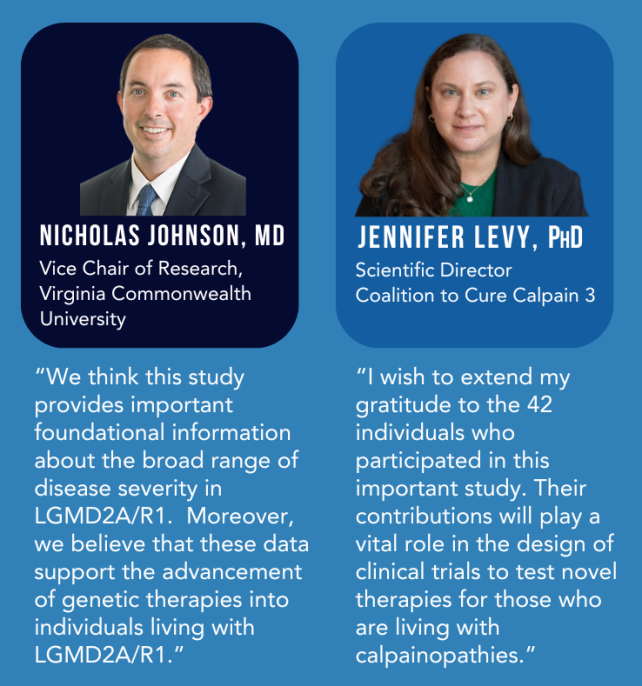
A team of LGMD researchers, called the GRASP-LGMD Consortium, published the baseline results of their LGMD2A/R1 clinical outcome study in the Annals of Clinical and Translational Neurology. The study, which was funded in part by a research grant from Coalition to Cure Calpain 3, enrolled 42 individuals across 11 international sites. Each participant completed several measures of their physical abilities as well as surveys indicating how symptoms of LGMD2A/R1 affect their lives.
A Critical Step in Preparing for Future Clinical Trials
The goal of the study, called GRASP-001, is to identify measures of muscle function called clinical outcome assessments (COAs) that can be used in clinical trials for LGMD2A/R1. Ideal COAs must be reliable and valid for evaluating weakness associated with this condition. The COAs identified in the study can be incorporated into the design of future trials to test if an investigational drug is effective.
Multiple Promising COAs
The researchers identified multiple COAs that reliably evaluate the functional abilities of individuals with LGMD2A/R1. These include:
- The North Star Assessment for Limb-Girdle-Type Dystrophies (NSAD): a multi-item test that assesses the ability to do tasks related to daily living, such as standing up from a seated position. Suitable for both ambulatory and non-ambulatory patients.
- The Performance of Upper Limb (PUL): an assessment of shoulder, elbow, and hand function. Suitable for both ambulatory and non-ambulatory patients.
- The 100-Meter Timed Test: the fastest a subject can travel 100 meters by walking and/or running.
Such measures could be used alone or in combination, depending on which is most appropriate for the trial and participant abilities.
What’s Next?
The data published in this study are from baseline visits. Researchers are now analyzing the visits that occurred 6-months and 12-months after the initial visits. This will help them understand if the COAs capture changes in function over time. A new study, GRASP-003, has been launched to include additional participants.