The most reliable way to diagnose calpainopathy is by performing a genetic test on a blood or saliva sample, which can confirm the presence of one or more mutations in the calpain 3 gene.
Alternatively, calpainopathy can be diagnosed by performing calpain 3 immunoblot analysis on tissue collected via a muscle biopsy. These studies can tell us whether the protein is present and whether it has the normal, expected, biological activity. A biopsy must be performed in a hospital and requires sedation, while a genetic test is non-invasive and usually less expensive.
C3 strongly encourages all patients to obtain a genetic diagnosis. Knowing a patient’s exact variant(s) is necessary for future clinical trials to evaluate potential therapies. Additionally, clinical trials will likely require a genetic diagnosis for eligibility, since researchers must be sure that study participants are affected by LGMD2A/R1 or LGMDD4 and not some other condition.
Several companies provide genetic testing for patients with undiagnosed muscle weakness. Although the cost of genetic testing is falling each year, some insurers remain resistant to reimbursing. If your neurologist suspects you have calpainopathy and are struggling to get a genetic test, please contact us.
Inheritance Patterns
We all receive two copies of each gene, one from each of our parents. Genes contain copies of instructions for how our body should look, grow, and develop. Within each of those genes, there are variations present that make us unique as individuals. These changes can be passed down from parent to child.
Sometimes, those changes don’t allow the gene product — in this case, calpain 3 — to work as it should.
There are two ways that calpainopathy can be inherited. In over 90% of cases, calpainopathy is inherited in an autosomal recessive manner. This means that it can be passed on through families, and that siblings can have the disease. This form of calpainopathy is called limb-girdle muscular dystrophy type 2A/R1 (LGMD2A/R1). Less commonly, calpainopathy is inherited in an autosomal dominant manner. This form is named LGMDD4, but has also been called LGMD1I or “autosomal dominant LGMD2A”. In this form of the disease, individuals with a single copy of the abnormal gene develop muscular dystrophy.
LGMD2A/R1 is inherited in an autosomal recessive manner, which means that a person needs two abnormal copies of the gene to develop LGMD2A/R1. This type of inheritance often – though not always – leads to siblings who have the same condition.
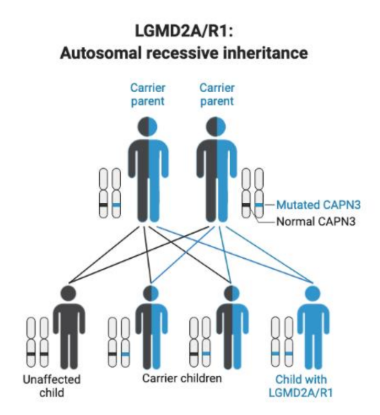
Individuals who have one copy of the abnormal gene containing an LGMD2A/R1-associated gene variant are not affected but are carriers and can pass the abnormal gene to their children.
If both parents are carriers for LGMD2A/R1 and neither is affected, there is a 25% chance their child will have LGMD2A/R1, a 50% chance the child will be a carrier for the disease, and a 25% chance the child will have two normal genes (unaffected and not a carrier).
A genetic counselor can help you understand your genetic test results.
Transmission of LGMD2A/R1 to children depends on the mutational status of each parent’s CAPN3 gene. The presence of CAPN3 mutations can be detected by genetic testing blood or saliva samples. Your healthcare provider can help you determine which test is best for you.
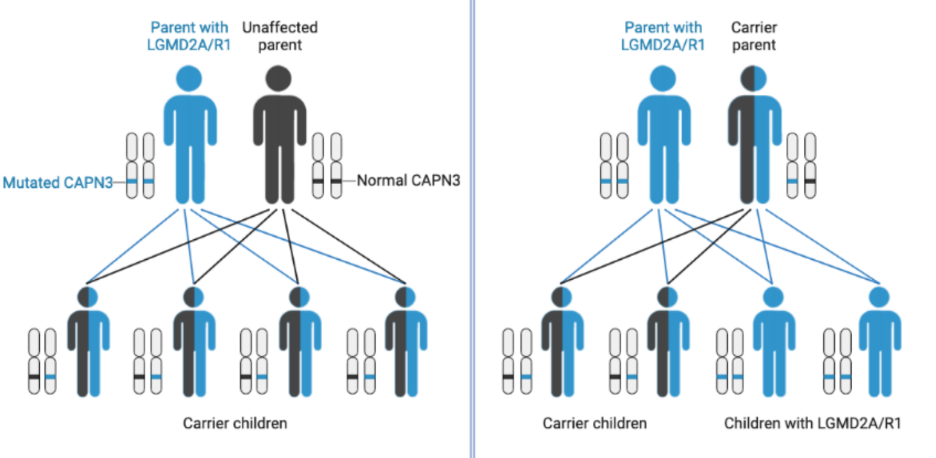
An individual affected with LGMD2A/R1 has two non-working copies of CAPN3, so their children will, by default, inherit a non-working copy. If their partner has two normal copies of the CAPN3 gene, then their children will each have one normal and one mutated gene. This means that all children will be carriers and will not be affected by LGMD2A/R1. Because CAPN3 mutations (also referred to as variants) are very rare, this is the most common scenario.
In the unlikely situation where one parent is affected and one parent is a carrier, each child has a 50% chance of being a carrier and a 50% chance of having LGMD2A/R1.
A genetic counselor can help you assess your risk of passing on LGMD2A/R1 to future children.
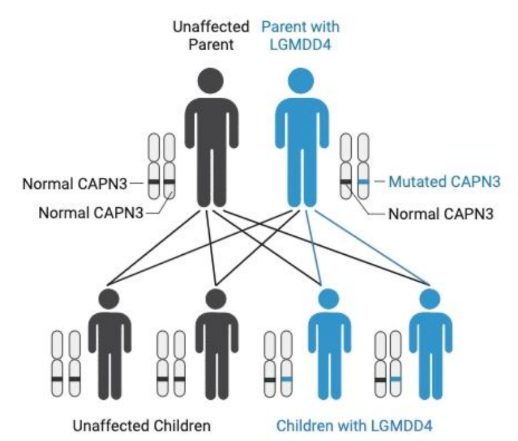
LGMDD4 is inherited in an autosomal dominant manner, which means just one abnormal copy of the gene causes an individual to develop the condition. LGMDD4 tends to be associated with a later onset and more slowly progressive symptoms than LGMD2A/R1.
This type of inheritance can lead to parents passing on the condition to their children. If one parent is affected by LGMDD4, then there is a 50% chance their child will have muscular dystrophy and a 50% chance that the child will have two normal genes (unaffected and not a carrier).
As of November 2026, the LGMDD4-associated variants identified include: c.146G>A, c.304C>T, c.598_612del15, c.640G>A, c.643_663del21, c.700G>A, c.759_761del3, c.1327T>C, c.1333G>A, c.1371C>G, c.1490C>T, c.1661A>C, c.1706T>C, c.1715G>C, and c.2257G>A. It is important to note that these variants can also be found in individuals with LGMD2A/R1, and that additional mutations may also cause autosomal dominant inheritance. A genetic counselor can help you understand your genetic test results.
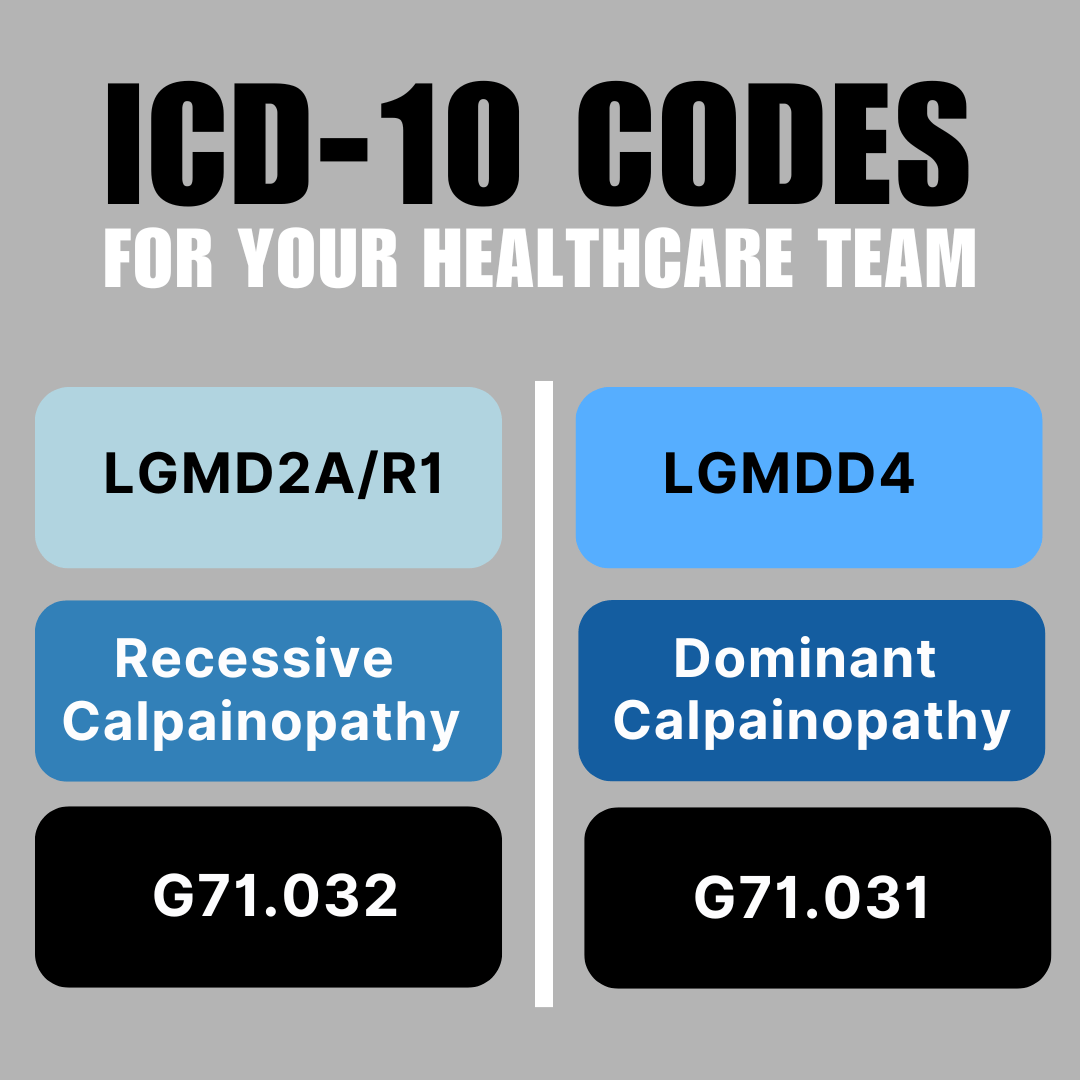
ICD-10 is a system used by US-based healthcare providers to classify and code health conditions, symptoms, procedures, and diseases. Learn more.